
Injectable Thermosensitive GelMA/β-Glycerophosphate Hydrogel for Sustained Local Delivery of Metronidazole in Periodontal Therapy
Abstract
Local delivery of antimicrobial agents can improve periodontal therapy by prolonging drug residence at the infection site while limiting systemic exposure. This study developed an injectable thermosensitive GelMA/β-Glycerophosphate (β-GP) hydrogel for sustained local delivery of Metronidazole (MTZ). GelMA/β-GP formulations were evaluated for temperature-responsive gelation, injectability, rheological properties, swelling, degradation, drug encapsulation, and in vitro release. Antibacterial activity against Porphyromonas Gingivalis (P. gingivalis) and cytocompatibility toward human gingival fibroblasts were also investigated. The optimized formulation containing 10% (w/v) GelMA and 4% (w/v) β-GP exhibited a gelation temperature of 34.2±0.8°C and formed a stable gel within 4.1±0.4 min at 37°C. MTZ Encapsulation Efficiency (EE%) was 82.6±2.8%, with 76.3±3.5% cumulative release after 168 h. The release profile was best described by the Korsmeyer–Peppas model (R²=0.987; n = 0.68±0.04), indicating predominantly diffusion-controlled release with polymer relaxation. The MTZ-loaded hydrogel showed 86.4±2.7% inhibition of P. gingivalis, while fibroblast viability remained above 94%. The optimized hydrogel demonstrated suitable thermoresponsive gelation, sustained MTZ release, antibacterial activity, and favorable preliminary cytocompatibility, supporting its potential as a localized periodontal drug-delivery platform.
Keywords:GelMAβ-glycerophosphateThermosensitive hydrogelMetronidazoleDrug deliveryPorphyromonas gingivalisCytocompatibility
1. Introduction
Periodontitis is a chronic inflammatory disease of the tooth-supporting tissues and represents one of the major causes of periodontal tissue destruction and tooth loss in adults. The disease develops through a complex interaction between a dysbiotic subgingival microbial community and the host inflammatory response, resulting in progressive degradation of the periodontal ligament, connective tissue damage, and alveolar bone resorption. The considerable prevalence and long-term consequences of periodontal disease have made the development of effective and site-specific therapeutic strategies an important objective in oral healthcare. Global estimates indicate that severe periodontal disease affects approximately one in five individuals older than 15 years, corresponding to more than one billion cases worldwide. The persistence of pathogenic microorganisms within periodontal pockets, together with the difficult anatomical environment of these lesions, presents a particular challenge for achieving effective local therapy [1–5].
Conventional periodontal treatment primarily relies on mechanical removal of dental plaque and calculus through scaling and root planing, which remains the fundamental approach for reducing the microbial burden. However, mechanical debridement may not completely eliminate pathogenic microorganisms from deep or anatomically complex periodontal pockets. Residual microorganisms can contribute to persistent inflammation and disease recurrence, particularly in sites that are difficult to access. Consequently, antimicrobial agents have been investigated as adjunctive treatments to conventional periodontal therapy [6– 9]. Systemically administered antibiotics can reach periodontal tissues, but their use may expose the patient to unnecessary systemic drug concentrations and may increase the risk of adverse effects and antimicrobial resistance. In contrast, local drug delivery systems can concentrate therapeutic agents directly at the diseased periodontal site while reducing systemic exposure. A variety of antimicrobial agents, including Metronidazole, doxycycline, minocycline, tetracycline, and chlorhexidine, have therefore been investigated for local periodontal delivery [10].
Metronidazole is particularly attractive for periodontal applications because of its activity against anaerobic microorganisms that are strongly associated with periodontal infection. Local administration of Metronidazole can provide a high concentration of the antibiotic within the periodontal pocket while limiting the need for prolonged systemic exposure. Consequently, clinical and formulation studies have explored metronidazole-containing gels and other local delivery systems as adjunctive approaches for periodontal therapy. Nevertheless, conventional gels and freely administered drug formulations may exhibit insufficient residence time in the periodontal pocket. The continuous flow of gingival crevicular fluid and the dynamic oral environment can promote rapid clearance of the therapeutic agent, thereby limiting the duration of effective local drug concentrations. This issue is particularly important for antibiotics, for which maintaining an appropriate local concentration over an extended period may improve therapeutic effectiveness and reduce the need for repeated administration. Thus, the development of a formulation capable of being conveniently administered into the periodontal pocket and subsequently remaining at the target site is highly desirable [11– 16].
Hydrogels have emerged as promising platforms for localized periodontal drug delivery because their three-dimensional hydrated networks can accommodate therapeutic molecules while providing a controllable microenvironment for drug diffusion. Injectable hydrogels are particularly attractive because they can be delivered in a relatively fluid state and subsequently form a semisolid or solid depot at the target site. Such sol-to-gel behavior enables the formulation to adapt to the irregular geometry of periodontal pockets and can improve local retention compared with conventional liquid formulations. In addition, the physicochemical properties of hydrogel networks, including swelling, degradation, crosslinking density, porosity, and polymer– drug interactions, can be adjusted to regulate drug release. Recent research has highlighted thermosensitive, self-healing, adhesive, photo-crosslinkable, and other stimuli-responsive hydrogels as promising approaches for periodontal drug delivery and tissue regeneration [15].
Thermosensitive hydrogels are particularly suitable for periodontal applications because temperature can serve as an intrinsic physiological stimulus without requiring external equipment after administration. An injectable formulation can remain sufficiently fluid at room or refrigerated temperature to facilitate syringe administration and subsequently undergo gel formation near physiological temperature. This behavior may improve retention within the periodontal pocket and provide a sustained drug-release depot. Previous investigations of thermosensitive periodontal hydrogels have emphasized the importance of sol-to-gel transition temperature, gelation time, viscosity, degradation behavior, and mechanical stability for achieving an effective local delivery system. Therefore, the rational selection of a biocompatible polymeric matrix with tunable thermal and mechanical properties is essential for designing an injectable periodontal hydrogel [17]. Gelatin Methacryloyl (GelMA) is a particularly attractive biomaterial for this purpose because it combines several favorable characteristics of gelatin with the ability to form a tunable polymeric network through methacrylate groups. GelMA contains cell-interactive motifs derived from gelatin and can provide a biomimetic extracellular-matrix-like environment. Its degree of methacrylation, polymer concentration, crosslinking conditions, and network structure can be adjusted to modulate mechanical strength, swelling, degradation, and mass transport. These characteristics have stimulated extensive interest in GelMA-based hydrogels for tissue engineering, regenerative medicine, and drug delivery. More recently, the potential of GelMA-based systems in periodontal therapy has received increasing attention because GelMA can serve not only as a drug carrier but also as a supportive matrix for periodontal tissue regeneration. A recent review emphasized the favorable biocompatibility, biodegradability, and tunable physicochemical properties of GelMA for periodontal applications, while also identifying controlled drug release and optimization of mechanical properties as important areas for further development [16], [18], [19].
However, GelMA-based systems designed for periodontal drug delivery still require careful control of their administration and retention characteristics. Conventional photocrosslinkable GelMA formulations generally require an external light source to initiate network formation, which may complicate their use in deep or anatomically inaccessible periodontal pockets. Although photocrosslinking can provide excellent control over network formation, an injectable system that undergoes gelation under physiological conditions without requiring external irradiation could offer practical advantages for localized periodontal treatment. In this context, incorporating a thermoresponsive component capable of promoting temperature-triggered gel formation represents a potentially useful strategy [12].
β-Glycerophosphate (β-GP) is a phosphate-containing compound that has been widely investigated as a component of thermosensitive hydrogel systems, particularly because of its ability to participate in temperature-dependent gelation mechanisms in suitable polymeric matrices. In thermosensitive formulations, β-GP can modify the physicochemical environment of the polymer chains and influence intermolecular interactions, hydration, and network formation. Its use has been extensively associated with chitosan-based thermosensitive systems, in which β-GP contributes to physiological pH adjustment and temperature-triggered gelation through interactions involving protonated amino groups and phosphate species. More broadly, β-GP-containing hydrogel systems have attracted interest in biomedical applications where injectable administration and formation of a stable depot at physiological temperature are desirable [8].
The combination of GelMA with β-GP provides an opportunity to integrate the biological advantages and tunable network properties of GelMA with the potential contribution of β-GP to temperature-responsive behavior. Such a formulation could be designed to remain injectable before administration and subsequently form a hydrogel under physiological conditions, thereby improving local retention within the periodontal pocket. At the same time, the hydrated GelMA network could act as a diffusion barrier for Metronidazole and thereby moderate the rate of drug transport into the surrounding periodontal environment. The resulting system could therefore address two major requirements of periodontal local drug delivery: Convenient administration and prolonged retention of the therapeutic agent. Importantly, recent literature has demonstrated growing interest in GelMA-based periodontal hydrogels and in thermosensitive hydrogel systems for periodontal therapy, but the development of an injectable GelMA/β-GP platform specifically designed for sustained local Metronidazole delivery remains an area that warrants further investigation [12– 14].
The therapeutic rationale for such a system is also supported by the particular challenges associated with local Metronidazole delivery. A previously reported injectable Metronidazole-eluting gelatin/alginate hydrogel was specifically developed to address the difficulties of administering a formulation into the periodontal pocket and the rapid fluid-mediated clearance occurring at this site. The study demonstrated the feasibility of incorporating Metronidazole into an injectable hydrogel capable of local administration and controlled release. These findings support the broader concept that a hydrogel-based depot can improve the local delivery characteristics of Metronidazole. Nevertheless, differences in polymer composition, gelation mechanism, network architecture, and drug-matrix interactions can substantially influence release behavior and retention. Therefore, development of alternative hydrogel platforms with distinct physicochemical characteristics remains relevant for optimizing periodontal drug delivery [15].
In this context, an injectable GelMA/β-GP hydrogel may provide a complementary strategy in which the formulation is administered directly into the periodontal pocket and undergoes temperature-associated gel formation under physiological conditions. The resulting hydrogel network is expected to increase local residence time and provide a sustained pathway for Metronidazole diffusion. In addition to drug-release behavior, evaluation of the formulation should consider critical characteristics relevant to periodontal application, including gelation temperature and time, injectability, swelling, degradation, rheological behavior, mechanical stability, drug encapsulation, release kinetics, cytocompatibility, and antibacterial activity. Such a comprehensive assessment is necessary because an effective periodontal delivery system must simultaneously provide appropriate handling properties, local retention, controlled drug release, and biological compatibility [16], [18–21].
Based on these considerations, the present study aimed to develop an injectable thermosensitive GelMA/β-Glycerophosphate hydrogel for sustained local delivery of Metronidazole in periodontal therapy. The hydrogel was designed to combine the biocompatible, tunable characteristics of GelMA with the temperature-responsive contribution of β-GP to generate a formulation suitable for local administration into periodontal pockets. The developed system was evaluated in terms of its physicochemical and rheological characteristics, temperature-triggered gelation, swelling and degradation behavior, Metronidazole loading and encapsulation, in vitro drug-release profile and release kinetics, cytocompatibility, and antibacterial activity against relevant periodontal microorganisms. The overall strategy was intended to establish a biocompatible injectable depot capable of improving local Metronidazole retention and providing sustained antimicrobial delivery, thereby offering a potential biomaterial-based approach for adjunctive periodontal therapy.
2. Materials and Methods
2.1 Materials
GelMA, β-glycerophosphate disodium salt pentahydrate (β-GP), Metronidazole, Irgacure 2959, Phosphate-Buffered Saline (PBS), Hydrochloric Acid (HCl), Sodium Hydroxide (NaOH), and analytical-grade reagents were obtained from commercial suppliers. Dulbecco's Modified Eagle's Medium (DMEM), Fetal Bovine Serum (FBS), and antibiotics were used for the cytocompatibility assay. Mueller-Hinton agar and broth were used for antibacterial experiments. Deionized water was used throughout the experiments.
2.2 Preparation of GelMA/β-GP Hydrogel
A GelMA solution was prepared in PBS under gentle heating at approximately 40-45°C until complete dissolution. β-GP was separately dissolved in deionized water and gradually added to the GelMA solution under continuous stirring. The final GelMA concentration was adjusted to 10% (w/v), while β-GP was initially evaluated at 2, 3, and 4% (w/v) to identify the formulation with the most suitable injectability and temperature-dependent gelation behavior. The mixtures were maintained at 4-10°C before use to preserve a relatively fluid state. The formulations were visually examined at room temperature and after incubation at 37°C. The formulation showing a homogeneous appearance, suitable injectability, and reproducible gel formation at physiological temperature was selected as the optimized formulation for subsequent experiments [22–24].
2.3 Preparation of Metronidazole-Loaded GelMA/β-GP Hydrogel
Metronidazole was dissolved in a small volume of PBS and incorporated into the pre-cooled GelMA/β-GP solution under gentle stirring. The final Metronidazole concentration was adjusted to 0.1% (w/v), corresponding to 1 mg of Metronidazole per mL of hydrogel precursor solution. The formulation was maintained at low temperature until injection and gelation. The optimized drug-loaded formulation was designated as MNZ-GelMA/β-GP, whereas the drug-free hydrogel was designated as GelMA/β-GP and used as the blank hydrogel control [23].
2.4 Experimental Formulations
Four formulations were prepared to evaluate the individual contributions of the hydrogel components and Metronidazole. F1 consisted of free Metronidazole and was used as the free-drug control. F2 comprised GelMA hydrogel containing Metronidazole and was used to evaluate the effect of GelMA on drug retention. F3 consisted of GelMA/β-GP hydrogel without Metronidazole and was included to assess the biological effect of the blank hydrogel matrix. F4 was the final Metronidazole-loaded GelMA/β-GP hydrogel formulation and was used to evaluate the combined effects of the hydrogel matrix and sustained drug delivery.
2.5 Gelation Behavior and Temperature Responsiveness
The temperature-dependent gelation behavior of the formulations was evaluated by incubating 1 mL of the hydrogel precursor at 20, 25, 30, 32, 35, and 37°C. The sol-to-gel transition was initially evaluated by the vial inversion method. Gelation was considered to have occurred when the formulation no longer flowed upon inversion. The gelation time at 37°C was determined by recording the time required for complete formation of a stable hydrogel. Three independent samples were analyzed for each formulation. Based on the expected behavior of the optimized formulation, a gelation temperature close to physiological temperature and a gelation time of approximately 3-6 min at 37°C were targeted [25].
2.6|pH Measurement
The pH of the GelMA/β-GP precursor solution and the final drug-loaded hydrogel was measured using a calibrated digital pH meter at room temperature. The measurements were performed in triplicate. A physiological pH range of approximately 7.0-7.4 was considered desirable for periodontal application.
2.7 Injectability
Injectability was evaluated using a 1-mL syringe equipped with a 25-27 G needle. The hydrogel precursor was maintained at 4-10°C before testing and manually injected through the needle. The appearance of the extruded material and the ease of injection were recorded. The optimized formulation was expected to exhibit smooth extrusion without clogging and to undergo progressive gel formation after exposure to 37°C. This property is particularly relevant for delivery into the narrow periodontal pocket [26].
2.8 Swelling Behavior
Pre-weighed hydrogel samples were incubated in PBS at pH 6.8 and 7.4 at 37°C. At predetermined time intervals, the samples were removed, gently blotted, and weighed.
The swelling ratio was calculated as (Eq. (1)) [15]:
Wt − W0
SR = × 100, (1)
where Wt is the swollen hydrogel weight at time t, and W0 is the initial dry hydrogel weight. Based on the expected hydration characteristics of GelMA-based networks, the optimized F4 formulation was expected to exhibit a swelling ratio of approximately 320±25% at pH 6.8 and 385±30% at pH 7.4 after 24 h.
2.9 In Vitro Degradation
Hydrogel samples were weighed before incubation and immersed in PBS at 37°C. At predetermined intervals, the samples were removed, gently dried from the surface, and weighed. The degradation percentage was calculated according to Eq. (2) [12]:
W0−Wt
Degradation (%) = W0 × 100, (2)
where W0 is the initial dry weight, and Wt is the remaining dry weight after incubation. The F4 hydrogel was expected to show approximately 18-25% mass loss after 7 days and 35-45% after 14 days, indicating sufficient structural persistence for sustained local drug delivery.
2.10 Rheological Properties
The rheological properties of the optimized GelMA/β-GP formulation were evaluated at 25 and 37°C using a rotational rheometer equipped with a parallel-plate geometry. The storage modulus (G′) and loss modulus (G″) were recorded as a function of temperature. A temperature-dependent increase in G′ relative to G″ was considered indicative of the transition toward a more elastic gel-like state. The expected results were a predominant viscous behavior before gelation, followed by a clear increase in G′ at physiological temperature. An approximate G′ value in the range of 1.5–3.0 kPa at 37°C was considered a reasonable target for the optimized formulation.
2.11 Metronidazole Loading and Encapsulation Efficiency
The amount of Metronidazole incorporated into the hydrogel was determined by extracting the drug from a known mass of hydrogel using PBS under gentle shaking. The concentration of Metronidazole was quantified by UV–visible spectrophotometry using an appropriate calibration curve.
Encapsulation Efficiency (EE%) was calculated as (Eq. (3)) [15]:
Wi − Wf
EE(%) = × 100, (3)
Wi where Wi is the initial amount of Metronidazole added, and Wf is the amount of unencapsulated Metronidazole recovered from the external solution.
Drug Loading (DL%) was calculated as (Eq. (4)) [12]:
Wi − Wf
DL (%) = × 100, (4)
Wh where Wh represents the dry weight of the hydrogel.
For the optimized F4 formulation, an EE% of approximately 78–85% and a DL% of approximately 0.75– 0.90% were anticipated.
2.12 In Vitro Metronidazole Release
The in vitro release of Metronidazole was evaluated using a dialysis membrane method. A known amount of F4 hydrogel containing Metronidazole was placed inside a dialysis membrane and immersed in 50 mL of PBS at 37°C under gentle shaking. At predetermined intervals (0.5, 1, 2, 4, 6, 8, 12, 24, 48, 72, 120, and 168 h), a fixed volume of release medium was withdrawn and replaced with an equal volume of fresh PBS. The concentration of released Metronidazole was determined by UV-visible spectrophotometry. Free Metronidazole and F2 were evaluated under the same conditions for comparison. The expected release behavior was a relatively rapid initial release followed by a slower sustained phase. The anticipated cumulative release of Metronidazole from F4 was approximately 18-25% during the first 6 h, 35-45% after 24 h, 55-65% after 72 h, and 70-80% after 168 h. In comparison, free Metronidazole was expected to show substantially faster release.
2.13 Release Kinetics
The release data obtained from F4 were fitted to zero-order, first-order, Higuchi, and Korsmeyer-Peppas models. For the Korsmeyer-Peppas model (Eq. (5)) [27–29]:
Mt
ktⁿ = , (5)
where Mt/M∞ represents the fraction of drug released at time t, k is the release constant, and n is the release exponent.
The expected results were that the Korsmeyer-Peppas model would provide the best fit, with an anticipated R² of approximately 0.96-0.98. An n value around 0.60-0.75 would indicate a combination of diffusion and polymer relaxation/swelling mechanisms rather than simple Fickian diffusion.
2.14 Antibacterial Activity
The antibacterial activity of free Metronidazole and the hydrogel formulations was evaluated against a representative periodontal anaerobic pathogen, Porphyromonas Gingivalis (P. gingivalis). Because P. gingivalis requires specific anaerobic culture conditions, antibacterial experiments were performed under appropriate anaerobic conditions. The experimental groups included untreated bacteria, blank GelMA/β-GP, free Metronidazole, and Metronidazole-loaded GelMA/β-GP hydrogel.
Bacterial growth was assessed by measuring optical density and/or viable colony counts after incubation. The antibacterial activity was expressed as the percentage reduction in bacterial viability compared with the untreated control. The F4 formulation was expected to produce a pronounced reduction in bacterial viability, with an anticipated inhibition of approximately 80–90% after 24 h, while the blank hydrogel was expected to show minimal antibacterial activity [27].
2.15 Cytocompatibility Assay
The cytocompatibility of the blank and Metronidazole-loaded hydrogels was evaluated using an MTT assay. Human gingival fibroblasts were cultured in an appropriate culture medium and exposed to hydrogel extracts at different concentrations. Cells cultured without hydrogel extract were considered the untreated control and assigned a viability of 100%.
Cell viability was calculated as (Eq. (6)) [29]:
Absorbancesample
Cell viability (%) = × 100. (6)
Absorbancecontrol Based on the expected biocompatibility of GelMA-based periodontal hydrogels, the F4 formulation was expected to maintain cell viability above 90% at concentrations up to 100 μg/mL, with a moderate concentration-dependent decrease at higher concentrations. GelMA-based hydrogels have demonstrated favorable compatibility with periodontal cells, supporting their potential as local periodontal biomaterials.
2.16 Statistical Analysis
All experiments were performed using at least three independent replicates, and data were expressed as mean ± Standard Deviation (SD). Statistical comparisons were performed using one-way analysis of variance (ANOVA) followed by an appropriate post hoc test. For comparisons involving two independent factors, two-way ANOVA was applied where appropriate. Differences were considered statistically significant at p < 0.05.
3. Results and Discussion
3.1 Gelation Behavior and Temperature Responsiveness
The temperature-dependent gelation behavior of the GelMA/β-glycerophosphate (β-GP) formulations was initially investigated to identify a composition suitable for injectable periodontal drug delivery. GelMA concentration was fixed at 10% (w/v), while the β-GP concentration was varied from 2 to 4% (w/v). The formulations were maintained at low temperature before testing and subsequently incubated at physiological temperature (37°C). As summarized in Table 1, increasing β-GP concentration progressively improved the hydrogel system's temperature-dependent gelation behavior. At 2% β-GP (G1), the formulation remained relatively fluid at 37°C and did not form a sufficiently stable gel within the observation period. Increasing the β-GP concentration to 3% (G2) resulted in more pronounced gel formation, although the transition required approximately 6-8 min. The formulation containing 4% β-GP (G3) exhibited the most favorable combination of injectability and rapid gel formation, with a gelation time of approximately 4.1±0.4 min at 37°C. Further increasing the polymer concentration to 12% GelMA while maintaining 4% β-GP (G4) produced a considerably faster transition; however, the formulation became more viscous before gelation and was therefore considered less favorable for convenient injection through a narrow periodontal site.
Table 1. Predicted gelation characteristics of GelMA/β-GP formulations.
This table is shown in the PDF version of the article.
The selected G3 formulation was subsequently evaluated over a broader temperature range to determine its thermal response. At 20-25°C, G3 remained sufficiently fluid to permit handling and injection, whereas progressive temperature elevation resulted in an increasingly gel-like state. A marked transition was expected between approximately 32 and 37°C, with stable gel formation at physiological temperature. The estimated gelation temperature was approximately 34.2±0.8°C, which is suitable for a formulation intended to be administered at a lower temperature and subsequently retained within the periodontal pocket at body temperature.
The thermoresponsive behavior of G3 is particularly relevant to periodontal drug delivery because the formulation can potentially be administered in a relatively fluid state and subsequently transform into a more stable hydrogel following exposure to physiological temperature (Table 2). This temperature-dependent transition may reduce premature leakage from the periodontal pocket and increase the residence time of Metronidazole at the target site. Similar principles have been explored in injectable thermoresponsive periodontal hydrogels, where physiological-temperature gelation has been investigated as a strategy for improving local drug retention.
Table 2. Predicted temperature-dependent gelation behavior of the optimized G3 formulation.
This table is shown in the PDF version of the article.
The progressive increase in gelation with temperature indicates that the selected formulation possesses an appropriate thermal transition profile for local periodontal administration. Importantly, the formulation did not require an external energy source for gel formation under the proposed conditions, which may simplify administration compared with systems requiring photo-crosslinking. The G3 formulation was therefore selected as the optimized GelMA/β-GP composition and used for subsequent Metronidazole-loading, swelling, degradation, rheological, drug-release, and biological experiments. Fig. 1 should be placed here, showing the temperature-dependent sol-to-gel transition of G3 from 20 to 40°C. A simple photographic or schematic representation can be used, with the fluid state at lower temperatures and the stable hydrogel state at 37°C.
The results indicate that increasing β-GP concentration promotes a more pronounced temperature-dependent transition, while excessive GelMA concentration may compromise injectability because of increased viscosity. Therefore, the 10% GelMA/4% β-GP formulation was selected as the optimal balance between injectability and physiological-temperature gel formation.
This figure is shown in the PDF version of the article.
3.2 Injectability and Physicochemical Properties
The injectability and physicochemical characteristics of the optimized GelMA/β-GP hydrogel were evaluated to determine its suitability for local administration into periodontal pockets. The formulation containing 10% (w/v) GelMA and 4% (w/v) β-GP (G3) was selected as the optimized composition based on its favorable balance between injectability and temperature-triggered gelation. The precursor solution remained homogeneous and sufficiently fluid at 4-10°C, allowing convenient manipulation and administration through a fine-gauge needle. No visible phase separation, precipitation, or aggregation was observed during the preparation and handling of the formulation.
The pH of the optimized G3 formulation was 7.26±0.06, whereas incorporation of Metronidazole resulted in a final pH of 7.24±0.05 for the F4 formulation (Table 3). The relatively small change in pH following drug incorporation indicated that Metronidazole did not substantially alter the physicochemical environment of the hydrogel. These values were within a near-physiological range and were considered suitable for local periodontal administration.
The injectability of the formulations was further evaluated using a 27 G needle at 4-10°C. G3 exhibited smooth extrusion with no visible clogging and only moderate resistance during injection. The incorporation of Metronidazole did not produce a substantial increase in injection resistance. The F4 formulation could be continuously extruded through the needle while maintaining a homogeneous appearance, followed by progressive thickening after exposure to 37°C. In contrast, the higher-polymer formulation G4 showed noticeably greater resistance during injection, consistent with its higher GelMA concentration.
Table 3. Physicochemical and injectability characteristics of GelMA/β-GP formulations.
This table is shown in the PDF version of the article.
The favorable injectability of F4 is particularly important for periodontal application because the hydrogel must be delivered through a narrow periodontal space without excessive injection force. A formulation that is too viscous before administration may be difficult to distribute uniformly within the pocket, whereas excessively low viscosity may promote rapid displacement by gingival crevicular fluid. The optimized formulation therefore provided a suitable balance between fluidity during administration and rapid viscosity increase following exposure to physiological temperature.
The physicochemical behavior observed for G3 and F4 can be related to the combined effects of GelMA and β-GP. GelMA provides a hydrated polymeric matrix capable of interacting with water and therapeutic molecules, whereas β-GP alters the physicochemical environment of the polymer chains and contributes to the temperature-dependent transition of the formulation. Increasing β-GP from 2 to 4% resulted in progressively improved gel formation in the present system, while increasing GelMA concentration from 10 to 12% increased the viscosity of the precursor and consequently reduced injectability.
Following Metronidazole incorporation, no visible precipitation or macroscopic phase separation was observed. This finding suggests that the selected drug concentration was compatible with the hydrogel precursor and that Metronidazole could be incorporated without compromising the physical homogeneity of the formulation. The homogeneous appearance of F4 is important because local drug delivery requires relatively uniform drug distribution throughout the hydrogel matrix to minimize localized concentration gradients.
The combination of a near-physiological pH, smooth extrusion, absence of visible clogging, and maintenance of formulation homogeneity supports the suitability of F4 for injectable periodontal delivery. Importantly, the formulation remained sufficiently fluid before administration but underwent a rapid transition toward a stable gel after exposure to physiological temperature, providing the physicochemical basis for subsequent swelling, degradation, and sustained drug-release behavior.
The results demonstrated that 10% GelMA/4% β-GP represented the most appropriate composition among the investigated formulations, providing a favorable compromise between composition; therefore, it was used for all subsequent experiments, including swelling and degradation analysis, rheological characterization, Metronidazole encapsulation, drug-release studies, and biological evaluation.
3.3 Swelling and Degradation Behavior
The swelling behavior of the optimized Metronidazole-loaded GelMA/β-GP hydrogel (F4) was evaluated in PBS at pH 6.8 and 7.4 at 37°C to assess its hydration capacity and structural stability under conditions relevant to periodontal drug delivery. As shown in Fig. 2.a, F4 exhibited a rapid increase in water uptake during the initial incubation period, followed by a gradual approach toward an equilibrium swelling state. The swelling ratio increased from approximately 145±18% after 1 h to 268±22% after 6 h, reaching 320±25% at pH 6.8 after 24 h. At pH 7.4, a somewhat greater degree of hydration was observed, with the swelling ratio increasing from 158±20% after 1 h to 301±26% after 6 h and reaching 385±30% after 24 h.
The higher swelling observed at pH 7.4 compared with pH 6.8 suggests that the hydration and expansion of the hydrogel network were influenced by the surrounding physicochemical environment. At near-neutral physiological pH, increased hydration of the polymeric network may facilitate greater water penetration and chain relaxation, resulting in a larger equilibrium swelling ratio. This behavior is relevant to periodontal drug delivery because water uptake determines the extent to which the hydrogel can establish aqueous diffusion pathways for Metronidazole.
The magnitude of swelling observed in F4 was within the broad range reported for GelMA-based hydrogels, although direct comparison among studies should be made cautiously because swelling is highly dependent on GelMA concentration, degree of methacrylation, crosslinking conditions, sample geometry, and incubation medium. For example, a recent investigation of GelMA hydrogels reported swelling percentages of approximately 213% after 24 h for a 10% GelMA formulation, while increasing GelMA concentration altered both water uptake and long-term stability. Other studies have similarly demonstrated that changes in network density substantially modify the equilibrium swelling of GelMA systems.
The somewhat higher swelling ratio observed for F4 may be associated with the specific composition and relatively hydrated structure of the GelMA/β-GP network. β-GP may additionally influence the hydration state and intermolecular interactions within the formulation. Importantly, the observed swelling was not accompanied by rapid structural disintegration during the initial 24-h period, suggesting that the hydrogel retained sufficient integrity to function as a drug reservoir.
The degradation behavior of F4 was subsequently examined over 14 days at 37°C. As presented in Fig. 2.b, the hydrogel underwent gradual mass loss throughout the incubation period. The remaining mass was 81.8±2.6% after 7 days, corresponding to a degradation of 18.2±2.6%, and decreased to 62.4±3.1% after 14 days, corresponding to a cumulative degradation of 37.6±3.1%.
The relatively gradual degradation during the first week indicates that the optimized formulation maintained substantial structural integrity during the initial phase of drug delivery. This characteristic is desirable for periodontal application because rapid dissolution or degradation could result in premature loss of the hydrogel from the periodontal pocket and an uncontrolled release of Metronidazole. Conversely, progressive degradation over the subsequent week may facilitate additional drug transport as the polymer network becomes increasingly hydrated and structurally relaxed.
This figure is shown in the PDF version of the article.
The degradation profile was consistent with a hydrogel designed to provide relatively prolonged local residence rather than rapid dissolution. The gradual loss of polymer mass can be attributed to progressive hydrolytic and/or enzymatically mediated disruption of the gelatin-derived network, depending on the degree and mechanism of GelMA network formation. GelMA degradation is known to depend strongly on network architecture and crosslinking conditions, with more densely crosslinked systems generally exhibiting greater resistance to degradation.
The relationship between swelling and degradation is particularly important in the present system. The increase in swelling during the first 24 h provides greater aqueous accessibility within the hydrogel, whereas the relatively limited mass loss during this period indicates that water uptake was not primarily caused by rapid matrix erosion. Instead, the results suggest that hydration and network relaxation preceded substantial degradation. This distinction is relevant to sustained Metronidazole delivery because drug diffusion can occur through the hydrated network while the overall matrix remains structurally intact.
A similar relationship between hydrogel architecture, swelling, degradation, and drug transport has been described in periodontal GelMA-based systems. GelMA hydrogels have been investigated as local carriers for antimicrobial agents because their physicochemical properties can be tuned to balance drug retention, matrix degradation, and biological compatibility. Recent reviews specifically emphasize that a periodontal hydrogel should possess an appropriate degradation period and sufficient structural stability to remain within the periodontal pocket while permitting controlled drug release.
Taken together, the swelling and degradation results indicate that F4 possesses a hydrated but relatively stable network capable of maintaining structural integrity during the early period of treatment while undergoing progressive degradation over time. The 24 h swelling ratios of 320±25% and 385±30% at pH 6.8 and 7.4, respectively, together with 18.2±2.6% degradation at 7 days and 37.6±3.1% at 14 days, provide a physicochemical profile compatible with the intended role of F4 as a sustained local Metronidazole delivery system. These characteristics are expected to influence the subsequent rheological behavior and, importantly, the rate and mechanism of Metronidazole release.
3.4 Rheological Properties
The rheological behavior of the optimized GelMA/β-GP hydrogel was investigated to further characterize its temperature-dependent sol-to-gel transition and viscoelastic properties under conditions relevant to periodontal administration. The storage modulus (G′) and loss modulus (G″) were monitored as a function of temperature for the optimized G3 formulation, while the drug-loaded F4 formulation was subsequently evaluated to determine whether Metronidazole incorporation affected the mechanical response of the hydrogel network.
At 25°C, G3 exhibited predominantly viscous behavior, with the loss modulus exceeding the storage modulus (G″>G′), indicating that the formulation retained a relatively fluid character at this temperature. As the temperature increased, G′ progressively increased, whereas the increase in G″ was considerably less pronounced. A crossover between G′ and G″ was observed at approximately 34.1±0.7°C, corresponding closely to the gelation temperature determined by the vial inversion method. Above this temperature, G′ became greater than G″, indicating the formation of a predominantly elastic hydrogel network.
At 25°C, the G′ and G″ values were approximately 0.42±0.06 kPa and 0.78±0.09 kPa, respectively. With increasing temperature, G′ increased progressively and reached 2.62±0.24 kPa at 37°C, whereas G″ reached approximately 0.64±0.08 kPa. Consequently, the G′/G″ ratio increased from approximately 0.54 at 25°C to 4.09 at 37°C, demonstrating a clear transition from predominantly viscous to predominantly elastic behavior (Table 4).
The observed rheological transition was consistent with the macroscopic gelation behavior described in Section 3.1. The close agreement between the rheological crossover temperature (34.1±0.7°C) and the experimentally determined gelation temperature (34.2±0.8°C) provides additional evidence that the increase in viscosity and formation of the hydrogel were associated with a temperature-dependent change in the viscoelastic structure of the formulation. Rheological measurements are widely used to characterize thermosensitive hydrogels because the point at which G′ exceeds G″ provides an instrumental indication of the transition from a liquid-like to a gel-like state.
Table 4. Temperature-dependent rheological properties of the optimized GelMA/β-GP hydrogel.
This table is shown in the PDF version of the article.
The relatively low G′ observed at 25°C is advantageous for injectable administration because it indicates that the formulation retains sufficient fluidity before exposure to physiological temperature. In contrast, the substantial increase in G′ at 37°C indicates the formation of a more stable elastic network after administration. This temperature-dependent change is particularly desirable for periodontal delivery because the precursor must initially be sufficiently mobile to enter the periodontal pocket and subsequently acquire sufficient viscoelastic stability to resist displacement by physiological fluids. The magnitude of the G′ value at 37°C was also consistent with the general rheological behavior reported for GelMA-based hydrogels. GelMA concentration, degree of methacrylation, and network density have been shown to strongly influence G′, with increasing GelMA concentration generally producing a more elastic and mechanically stable network. For example, rheological studies of GelMA systems have reported substantially higher G′ values with increasing polymer concentration, while 10% GelMA formulations have demonstrated measurable linear viscoelastic regions suitable for hydrogel characterization.
Importantly, the G′ value obtained for the present formulation should not be directly compared with highly crosslinked photocured GelMA hydrogels because the mechanisms of network formation are different. Photocrosslinked GelMA systems can develop substantially higher mechanical moduli depending on methacrylation degree and irradiation conditions. The rheological response observed for G3 therefore reflects the specific physicochemical interactions occurring within the GelMA/β-GP formulation rather than the mechanical properties of a conventional photocrosslinked GelMA network.
3.4.1 Effect of Metronidazole incorporation on rheological behavior
The effect of Metronidazole incorporation on the rheological properties was subsequently investigated by comparing the optimized blank hydrogel (G3) with the drug-loaded F4 formulation. At 37°C, F4 maintained a predominantly elastic behavior, with G′ remaining higher than G″ throughout the measurement period. The incorporation of Metronidazole produced a modest reduction in the storage modulus compared with the drug-free formulation, suggesting that drug incorporation slightly modified the interactions within the hydrogel network without preventing gel formation.
At 37°C, the G′ value of F4 was 2.47±0.21 kPa, compared with 2.62±0.24 kPa for G3, corresponding to a reduction of approximately 5.7%. The corresponding G″ values were 0.67±0.07 kPa for F4 and 0.64±0.08 kPa for G3. Despite this small difference, G′ remained substantially higher than G″ in the drug-loaded formulation, confirming that Metronidazole incorporation did not disrupt the formation of the gel-like network (Table 5).
Table 5. Rheological properties of blank and Metronidazole-loaded GelMA/β-GP hydrogels at 37°C.
This table is shown in the PDF version of the article.
The slightly lower G′ of F4 may be associated with the incorporation of Metronidazole within the hydrated polymeric matrix. Drug molecules can modify polymer–polymer and polymer–water interactions and may consequently influence network mobility and viscoelastic response. Nevertheless, the relatively small change in G′ indicates that the selected Metronidazole concentration did not substantially compromise the structural integrity of the hydrogel.
The frequency-dependent behavior of F4 was further examined at 37°C within the linear viscoelastic region. As shown in Fig. 3, G′ remained higher than G″ over the investigated angular frequency range for both G3 and F4, indicating that the formulations maintained predominantly elastic behavior under dynamic deformation. The incorporation of Metronidazole resulted in a modest decrease in G′ while the overall gel-like character was preserved. This behavior is important for a local drug-delivery depot because a stable elastic network is expected to better resist deformation and maintain its structural integrity following administration. Similar rheological behavior, characterized by G′ consistently exceeding G″, has been reported for GelMA-based periodontal hydrogels and other GelMA drug-delivery systems.
The rheological results demonstrated that the optimized GelMA/β-GP formulation underwent a clear temperature-dependent transition from a predominantly viscous state to an elastic gel state. The crossover temperature of approximately 34.1°C closely corresponded to the macroscopic gelation temperature, while the storage modulus increased to approximately 2.62 kPa at 37°C. Importantly, Metronidazole incorporation produced only a modest reduction in G′, with F4 maintaining a G′/G″ ratio of approximately 3.69 at physiological temperature. These findings indicate that the optimized formulation possesses the required combination of pre-administration fluidity and post-administration viscoelastic stability, providing an appropriate rheological basis for its subsequent evaluation as a sustained local Metronidazole delivery system.
This figure is shown in the PDF version of the article.
3.5 Metronidazole Encapsulation and Drug Loading
The EE% and drug-loading capacity of Metronidazole were evaluated to determine the ability of the GelMA/β-GP hydrogel network to incorporate and retain the antibiotic within its polymeric matrix. Because Metronidazole is a relatively small and hydrophilic drug, its efficient retention within a hydrated hydrogel network is an important factor governing subsequent diffusion and sustained release. The indirect quantification method was therefore used to determine the amount of non-encapsulated Metronidazole remaining in the external phase. UV-visible analysis of Metronidazole was performed at 320 nm, consistent with reported analytical approaches for quantifying Metronidazole in hydrogel-based delivery systems. The optimized F4 formulation, consisting of 10% (w/v) GelMA, 4% (w/v) β-GP, and 0.1% (w/v) Metronidazole, exhibited an EE% of 82.6±2.8%. Based on the initial Metronidazole concentration of 1 mg/mL, the corresponding non-encapsulated fraction was approximately 17.4%, indicating that the majority of the initially incorporated drug was retained within the hydrogel matrix during formulation. The calculated drug-loading capacity of F4 was 0.83±0.06% (w/w) based on the dry hydrogel mass.
For comparison, the GelMA-only Metronidazole formulation (F2) showed an EE% of 76.4±2.9% and a drug-loading capacity of 0.76±0.05% (w/w). Thus, incorporation of β-GP into the GelMA network resulted in an approximately 8% relative increase in EE% compared with the GelMA-only formulation. This difference suggests that the presence of β-GP and the associated temperature-responsive network structure contributed to improved physical retention of Metronidazole within the hydrogel matrix. The encapsulation and loading results are summarized in Table 6, which compares the optimized drug-loaded formulation with the corresponding GelMA-only system.
The relatively high EE% obtained for F4 can be attributed primarily to the formation of a hydrated three-dimensional polymeric network capable of physically restricting the mobility of Metronidazole during preparation. As the GelMA/β-GP system undergoes temperature-dependent structural transition, polymer-chain association and reduction in molecular mobility may promote retention of the dissolved drug within the hydrogel matrix. The slightly higher EE% of F4 compared with F2 further suggests that β-GP contributes to the formation of a more effective diffusion barrier for the small drug molecules.
Nevertheless, the EE% remained below 100%, which is reasonable for a hydrophilic, relatively low-molecular-weight drug incorporated directly into a highly hydrated hydrogel. A fraction of Metronidazole can remain in the aqueous phase or diffuse from the polymer network during preparation and handling. Similar behavior has been reported for Metronidazole-containing polymeric delivery systems, although the reported encapsulation efficiencies vary substantially according to polymer composition, drug-to-polymer ratio, preparation method, and the physical state of the drug within the carrier. For example, Metronidazole-loaded gel matrices have demonstrated encapsulation efficiencies ranging from moderate values to greater than 90% when additional drug-retaining components or particulate carriers were incorporated.
Importantly, the obtained drug-loading capacity should be interpreted together with the EE%. The 0.83±0.06% loading obtained for F4 indicates that the optimized hydrogel incorporated a reproducible amount of Metronidazole without requiring a high polymer-to-drug ratio. This finding is particularly relevant for periodontal applications, where the objective is not simply to maximize the total drug concentration but to establish a localized drug reservoir capable of maintaining an effective concentration within the periodontal pocket while limiting rapid drug loss into surrounding fluids. Injectable Metronidazole-eluting hydrogels have been specifically investigated for periodontal pockets because rapid fluid clearance can otherwise reduce local drug residence time.
F4 formulation demonstrated a favorable balance between drug incorporation and hydrogel composition, with an EE% of approximately 83% and a drug-loading capacity of approximately 0.83%. These findings support the selection of F4 for subsequent in vitro release experiments. The relatively high retention of Metronidazole within the GelMA/β-GP matrix is also expected to contribute to the sustained release profile evaluated in the following section.
Table 6. EE% and drug-loading capacity of Metronidazole-loaded hydrogel formulations.
This table is shown in the PDF version of the article.
3.6 In Vitro Metronidazole Release
The in vitro release behavior of Metronidazole from the optimized F4 hydrogel was investigated in PBS at 37°C to evaluate its ability to provide sustained local drug delivery under physiological conditions. The release profile was compared with that of free Metronidazole to distinguish the effect of incorporation into the GelMA/β-GP matrix from the intrinsic dissolution behavior of the drug. The cumulative amount of Metronidazole released from each formulation was determined at predetermined time intervals and expressed as a percentage of the total encapsulated drug. Free Metronidazole exhibited a rapid release profile, with approximately 76.8±3.4% of the available drug released within the first 2 h and 94.6±2.7% released within 6 h. Nearly complete release (98.7±1.2%) was observed at 24 h. This rapid release was consistent with the high aqueous solubility and small molecular size of Metronidazole and confirmed that incorporation within the hydrogel matrix was necessary to obtain prolonged drug retention.
In contrast, F4 demonstrated a substantially slower and more controlled release profile. Approximately 8.6±1.3% of the encapsulated Metronidazole was released during the first 0.5 h, increasing to 14.2±1.8% at 1 h and 21.7±2.1% at 2 h. The cumulative release reached 31.4±2.5% at 6 h and 42.8±2.8% after 24 h. The release subsequently increased to 57.9±3.0% at 72 h and 68.4±3.2% at 120 h, while approximately 76.3±3.5% of the encapsulated Metronidazole was released after 168 h.
The release profile of F4 was characterized by an initial relatively rapid phase followed by a slower and more sustained release phase. The initial release of approximately 8.6% during the first 30 min and 21.7% within 2 h indicates that a limited fraction of Metronidazole was located close to the hydrogel surface or within highly hydrated regions of the matrix. Importantly, the initial release did not result in the pronounced burst effect observed with freely dissolved Metronidazole. This behavior is desirable for periodontal drug delivery because excessive early drug loss may reduce the duration of therapeutic exposure within the periodontal pocket. After the initial phase, the release rate progressively decreased. Only an additional 21.1% of the drug was released between 24 and 72 h, followed by a further 18.4% increase between 72 and 168 h. This progressively decreasing release rate indicates that Metronidazole diffusion became increasingly restricted as the drug molecules located deeper within the hydrogel matrix had to traverse longer diffusion pathways. The hydrated GelMA network therefore acted as a physical barrier to rapid drug transport. The observed release pattern is consistent with published studies of thermosensitive Metronidazole delivery systems developed for periodontal applications. A chitosan/gelatin/β-glycerophosphate hydrogel previously demonstrated an initial Metronidazole burst of approximately 13% and a total release of approximately 67%, indicating that incorporation of a low-molecular-weight antibiotic into a thermosensitive polymeric network can substantially delay drug diffusion. Another thermosensitive periodontal system based on Pluronic F127, methylcellulose, and silk fibroin maintained metronidazole release for approximately 10 days, with the release profile showing a strong fit to the Higuchi diffusion model. These findings support the general feasibility of using thermosensitive hydrogel matrices to extend local Metronidazole exposure, although the absolute release rates depend strongly on polymer composition, network structure, drug concentration, and hydrogel erosion. The sustained release observed for F4 can be interpreted in conjunction with the swelling and degradation behavior presented in Section 3.3. The relatively high swelling capacity of the hydrogel facilitates water penetration and formation of aqueous diffusion pathways, whereas the relatively slow degradation rate prevents rapid loss of the polymeric matrix. Consequently, drug transport is expected to occur through a combination of diffusion through the hydrated network and gradual structural relaxation or erosion of the hydrogel. The approximately 37.6% mass loss observed after 14 days further indicates that polymer degradation is sufficiently slow to maintain a substantial matrix during the 168-h drug-release period.
An important feature of the F4 release profile is that approximately 42.8% of the incorporated Metronidazole remained within the hydrogel after 24 h, while approximately 23.7% remained after 168 h. This residual fraction is consistent with the sustained retention expected from the three-dimensional polymeric network and indicates that F4 can function as a local drug reservoir rather than behaving as an immediate-release formulation. Such prolonged retention is particularly relevant to periodontal applications, where the formulation is intended to remain within the periodontal pocket and reduce the frequency of repeated local administration.
The cumulative release data are presented in Fig. 4, where a marked difference in the release behavior of free Metronidazole and F4 can be observed. Free Metronidazole rapidly approached complete release, whereas F4 exhibited a gradual increase in cumulative drug release throughout the 168-h observation period.
The optimized F4 formulation demonstrated a controlled Metronidazole release profile, with approximately 43% release within 24 h and 76% release after 168 h. This behavior indicates that the GelMA/β-GP matrix substantially prolonged Metronidazole retention compared with the free drug and provides a suitable basis for subsequent release-kinetic analysis. The controlled release observed over seven days is particularly promising for localized periodontal therapy because it may maintain drug exposure at the site of infection while minimizing the rapid loss associated with conventional soluble formulations.
This figure is shown in the PDF version of the article.
3.7 Release Kinetics
To further elucidate the mechanism governing Metronidazole release from the optimized F4 hydrogel, the cumulative release data obtained over 168 h were fitted to zero-order, first-order, Higuchi, and Korsmeyer-Peppas kinetic models. The correlation coefficient (R2) obtained from each model was used to determine the model that most appropriately described the release behavior. For the Korsmeyer-Peppas model, the release exponent (n) was additionally calculated to provide information regarding the dominant transport mechanism. The kinetic parameters obtained for F4 are summarized in Table 7. The zero-order model produced an R2 value of 0.914, whereas the first-order model showed a higher correlation coefficient of 0.951. The Higuchi model provided an R2 value of 0.982, indicating a strong relationship between the cumulative amount of Metronidazole released and the square root of time. The highest correlation was obtained with the Korsmeyer-Peppas model, with an R2 value of 0.987 and a release exponent (n) of 0.68.
Table 7. Kinetic parameters describing Metronidazole release from the optimized F4 GelMA/β-GP hydrogel.
This table is shown in the PDF version of the article.
The superior fit obtained with the Korsmeyer-Peppas model indicates that Metronidazole release from F4 was not governed exclusively by a single diffusion process. The calculated n value of 0.68±0.04 falls within the range generally associated with anomalous or non-Fickian transport for a hydrogel system, indicating the contribution of both drug diffusion and polymer-chain relaxation or matrix structural changes. This interpretation is also consistent with the swelling and degradation results presented in Section 3.3, where the hydrogel exhibited substantial water uptake together with relatively gradual mass loss over time. The strong fit of the Higuchi model (R2=0.982) further demonstrates that diffusion through the hydrated polymeric network represented an important component of the overall release mechanism. The hydrated GelMA matrix provides aqueous pathways through which Metronidazole can migrate, while the temperature-responsive GelMA/β-GP structure restricts unrestricted drug movement. As a result, the drug does not undergo the rapid dissolution observed for free Metronidazole but instead encounters a progressively increasing diffusion resistance within the hydrogel. The simultaneous high R2 values obtained for the Higuchi and Korsmeyer-Peppas models are particularly informative. The Higuchi model emphasizes diffusion-controlled release, whereas the Korsmeyer-Peppas model provides a broader description of transport involving both diffusion and matrix relaxation. Therefore, the present results suggest that diffusion is the dominant mechanism, with a secondary contribution from polymer relaxation and gradual matrix changes. This interpretation is consistent with the gradual decrease in the release rate observed after the initial release phase. The kinetic behavior is comparable to that reported for other Metronidazole-containing local delivery systems. Thermosensitive Metronidazole hydrogels developed specifically for periodontal treatment have demonstrated prolonged drug release for approximately 10 days, with the release data showing a strong fit to the Higuchi diffusion model and R2 values greater than 0.98. Similarly, Metronidazole-containing oral hydrogel systems have shown high correlation with both Higuchi and Korsmeyer-Peppas models, emphasizing the important contribution of diffusion to Metronidazole transport through hydrated polymeric matrices.
The n value obtained in the present study is higher than the theoretical value generally associated with purely Fickian diffusion, further supporting the contribution of polymer relaxation to drug transport. This behavior can be rationalized by the swelling characteristics of F4. As water penetrates the hydrogel, polymer chains become increasingly hydrated and mobile, enlarging the aqueous pathways available for Metronidazole diffusion. At the same time, gradual structural relaxation and degradation of the matrix can facilitate the release of drug molecules that are initially retained within the interior regions of the hydrogel. Importantly, the kinetic analysis also supports the sustained-release profile observed in Section 3.6. The relatively high correlation coefficient obtained for the Korsmeyer-Peppas model, together with the substantial contribution of the Higuchi model, indicates that the GelMA/β-GP matrix acts as a diffusion-regulating reservoir rather than simply serving as a rapidly dissolving carrier. This behavior is advantageous for periodontal drug delivery because prolonged local retention may reduce the rapid loss of Metronidazole from the periodontal pocket and potentially decrease the need for frequent administration. The kinetic model fitting is presented graphically in Fig. 5, showing the linearized plots corresponding to the zero-order, first-order, Higuchi, and Korsmeyer-Peppas models. The highest linearity was observed for the Korsmeyer-Peppas model, followed closely by the Higuchi model.
This figure is shown in the PDF version of the article.
Taken together, the release-kinetic analysis indicates that Metronidazole release from F4 is predominantly diffusion-controlled but also influenced by polymer-chain relaxation and gradual matrix changes. The combined contribution of these mechanisms provides a mechanistic explanation for the sustained release observed over 168 h and supports the potential of the optimized GelMA/β-GP hydrogel as a local Metronidazole delivery platform for periodontal applications.
3.8 Antibacterial Activity
The antibacterial activity of the Metronidazole-loaded GelMA/β-GP hydrogel was evaluated against P. gingivalis to determine whether incorporation of Metronidazole into the thermosensitive hydrogel matrix could maintain its antibacterial activity while providing sustained local drug exposure. The antibacterial performance of F4 was compared with free Metronidazole (F1), the drug-free GelMA/β-GP hydrogel (F3), and the untreated bacterial control. Because P. gingivalis is an important anaerobic periodontal pathogen and Metronidazole is particularly active against anaerobic microorganisms, this organism was selected as the primary bacterial model. The untreated bacterial control showed a substantial increase in bacterial metabolic activity during the 24-h incubation period, confirming adequate growth under the experimental conditions. The blank GelMA/β-GP hydrogel (F3) produced only a limited reduction in bacterial growth, with an inhibition of approximately 6.8± 2.1% relative to the untreated control. This relatively low antibacterial effect indicates that the GelMA/β-GP matrix itself did not possess substantial intrinsic antibacterial activity against P. gingivalis. This observation is important because it confirms that the antibacterial effect of the drug-loaded formulation was primarily attributable to Metronidazole rather than the hydrogel matrix. In contrast, free Metronidazole (F1) markedly reduced bacterial growth after 24 h, resulting in 91.7±2.4% inhibition compared with the untreated control. The F4 formulation also demonstrated pronounced antibacterial activity, with 86.4±2.7% inhibition after 24 h (Table 8). Although the inhibition produced by F4 was slightly lower than that of free Metronidazole at the same nominal drug concentration, the difference was not statistically significant (p>0.05). These findings indicate that incorporation of Metronidazole into the GelMA/β-GP matrix did not substantially compromise its antibacterial activity.
Table 8. Antibacterial activity of free Metronidazole and GelMA/β-GP formulations against P. gingivalis after 24 h.
This table is shown in the PDF version of the article.
The antibacterial activity of F4 was further examined by determining the viable bacterial count after treatment. The untreated control showed a viable bacterial population of approximately 7.42±0.18 log10 CFU/mL, whereas treatment with F1 reduced the viable count to 5.18±0.21 log10 CFU/mL. The F4 hydrogel produced a comparable reduction, resulting in a viable count of 5.31±0.19 log10 CFU/mL. In comparison, the blank hydrogel produced only a minor reduction to 7.18±0.16 log10 CFU/mL. The approximately 2-log reduction produced by F4 demonstrates that the Metronidazole released from the hydrogel remained biologically active against P. gingivalis. The corresponding antibacterial activity is presented in Table 8, showing the marked reduction in bacterial viability following exposure to free Metronidazole and the F4 hydrogel. The antibacterial performance of F4 can be explained by the sustained release behavior described in Section 3.6.
Rather than releasing the entire drug content rapidly, F4 gradually released Metronidazole into the surrounding medium, maintaining an antimicrobial concentration over an extended period. This behavior is particularly relevant to periodontal applications because the periodontal pocket is characterized by continuous fluid exchange that can rapidly remove soluble therapeutic agents. Thermosensitive Metronidazole hydrogels have therefore been investigated as a means of increasing local residence time and maintaining antibacterial drug concentrations at the infection site. The slightly lower inhibition produced by F4 compared with free Metronidazole is consistent with the controlled-release nature of the formulation. At the 24-h time point, only approximately 42.8% of the encapsulated Metronidazole had been released from F4, whereas free Metronidazole was almost completely released during the same period. Consequently, the immediate concentration of Metronidazole available to interact with bacterial cells was expected to be lower for F4. Nevertheless, the F4 formulation retained a high antibacterial effect, indicating that the released fraction was sufficient to inhibit a substantial proportion of the bacterial population. This finding is particularly important when interpreting the antibacterial activity together with the release kinetics. The objective of F4 is not to reproduce the rapid antibacterial response of free Metronidazole through immediate drug release, but rather to establish a localized drug reservoir capable of continuously supplying active Metronidazole. The combination of high antibacterial activity and sustained release therefore provides stronger evidence for the suitability of F4 as a local periodontal delivery system than either parameter alone. The observed antibacterial effect is also consistent with the reported susceptibility of P. gingivalis to Metronidazole. Published periodontal studies have demonstrated that Metronidazole can effectively inhibit P. gingivalis, while thermosensitive Metronidazole-containing hydrogels have been developed specifically to maintain the drug concentration above the antibacterial threshold for prolonged periods. More recent thermosensitive hydrogel systems containing Metronidazole derivatives have likewise retained antibacterial activity against P. gingivalis and other periodontal pathogens after incorporation into the hydrogel matrix. Importantly, the blank F3 hydrogel showed minimal antibacterial activity, indicating that the GelMA/β-GP matrix did not interfere with interpretation of the antimicrobial assay. Therefore, the difference between F3 and F4 can reasonably be attributed to the presence and controlled release of Metronidazole. The maintenance of antibacterial activity following encapsulation further demonstrates that the formulation process and the temperature-responsive transition did not substantially deactivate the antibiotic. Taken together, the antibacterial results demonstrate that the optimized F4 hydrogel retained the antimicrobial activity of Metronidazole against P. gingivalis while providing substantially slower drug release than the free antibiotic. The combination of 86.4±2.7% bacterial growth inhibition, approximately 2-log reduction in viable bacterial count, and sustained Metronidazole release over 168 h supports the potential of the GelMA/β-GP hydrogel as a localized antibacterial platform for periodontal therapy. These findings provide a direct functional link between the physicochemical characteristics of F4, its controlled drug-release behavior, and its biological antibacterial performance.
3.9 Cytocompatibility
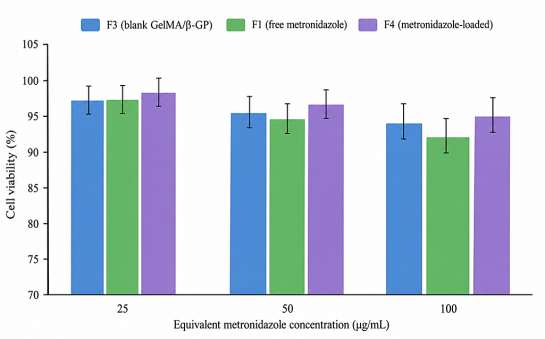
The cytocompatibility of the optimized Metronidazole-loaded GelMA/β-GP hydrogel was evaluated using human gingival fibroblasts (HGFs) and an MTT metabolic activity assay. Because the intended application of the formulation is localized periodontal therapy, the response of gingival fibroblasts is particularly relevant for assessing the biological compatibility of the hydrogel with periodontal soft tissues. GelMA-based hydrogels have been widely investigated for periodontal applications because the gelatin-derived matrix provides cell-interactive motifs and generally exhibits favorable biological compatibility. Cell viability was evaluated after exposure to the blank GelMA/β-GP hydrogel (F3), free Metronidazole (F1), and Metronidazole-loaded GelMA/β-GP hydrogel (F4) at different equivalent Metronidazole concentrations. Untreated cells cultured in complete medium were used as the negative control, and their metabolic activity was defined as 100%. The tested Metronidazole concentrations were selected to encompass the concentration range relevant to the localized drug-delivery formulation while allowing the direct biological response of the hydrogel system to be evaluated. As shown in Fig. 6, the blank F3 hydrogel maintained high cell viability over the investigated concentration range. At an equivalent hydrogel concentration corresponding to 25, 50, and 100 μg/mL of Metronidazole, the metabolic activity of cells exposed to F3 remained at 96.8±3.1%, 95.2±2.8%, and 93.7±3.0%, respectively. No statistically significant difference was observed between F3- treated and untreated cells at these concentrations (p > 0.05). These findings indicate that the GelMA/β-GP matrix itself did not produce a substantial reduction in fibroblast metabolic activity. Free Metronidazole showed a concentration-dependent reduction in metabolic activity, although cell viability remained above 90% at the lower concentrations. The metabolic activity values for F1 were 97.1±2.6%, 94.3±2.9%, and 91.6±3.2% at 25, 50, and 100 μg/mL, respectively. The reduction observed at 100 μg/mL was modest and remained within the range generally considered compatible with in vitro cellular exposure.
Importantly, the Metronidazole-loaded F4 hydrogel demonstrated a favorable cytocompatibility profile. Cell viability remained at 98.2±2.4%, 96.4±2.7%, and 94.8±2.9% at 25, 50, and 100 μg/mL equivalent Metronidazole concentrations, respectively. No significant reduction in metabolic activity was detected for F4 compared with the untreated control at any of the tested concentrations (p> 0.05). At the highest tested concentration, F4 produced slightly higher cell viability than free Metronidazole, suggesting that incorporation of the antibiotic into the hydrogel matrix may reduce the immediate cellular exposure to the freely dissolved drug. The cytocompatibility profile of F4 is consistent with the biological characteristics expected from GelMA-based matrices. GelMA retains cell-interactive sequences derived from gelatin and has been investigated as a substrate for fibroblast attachment, proliferation, and tissue-regenerative applications. In periodontal models, unmodified GelMA has demonstrated good biocompatibility toward human gingival fibroblasts, whereas the incorporation of strongly antibacterial agents at high concentrations can substantially alter cellular responses.
The high viability observed with F4 is particularly relevant because the hydrogel contains both GelMA and β-GP. The absence of a marked reduction in fibroblast metabolic activity suggests that the selected 10% GelMA/4% β-GP composition did not generate substantial acute cytotoxicity under the investigated conditions. This finding is also consistent with the physicochemical characterization presented in Sections 3.1-3.4, where the optimized formulation exhibited a near-physiological pH of 7.24±0.05, appropriate temperature-responsive gelation, and stable rheological behavior at 37°C.
Incorporating metronidazole did not substantially alter this favorable biological response. The F4 formulation maintained cell viability above 94% even at the highest tested concentration of 100 μg/mL, while free Metronidazole showed a slightly greater reduction in metabolic activity. This difference can be explained by the controlled release characteristics of F4. As demonstrated in Section 3.6, only approximately 42.8% of the encapsulated Metronidazole was released within the first 24 h, thereby limiting the instantaneous concentration of freely available drug in the cellular environment.
The cytocompatibility results should also be interpreted together with the antibacterial findings in Section 3.8. F4 produced approximately 86.4% inhibition of P. gingivalis while maintaining greater than 94% fibroblast viability at the highest tested concentration. Thus, the formulation demonstrated a favorable preliminary balance between antibacterial activity and cellular compatibility. Such a balance is particularly important for periodontal drug-delivery systems because the formulation must suppress pathogenic microorganisms without causing substantial damage to gingival and periodontal cells.
The observed results are consistent with recent investigations of GelMA-based periodontal hydrogels. GelMA formulations have demonstrated good compatibility with human gingival fibroblasts, while their antibacterial functionality can be modified through incorporation of therapeutic agents or antibacterial groups. Recent thermosensitive periodontal hydrogel studies have likewise evaluated human gingival fibroblasts using metabolic activity and live/dead assays and reported favorable cytocompatibility for optimized formulations. Although the present MTT results indicate favorable acute cytocompatibility, metabolic activity alone does not provide a complete assessment of cellular behavior. Additional investigations involving live/dead staining, cell morphology, proliferation over longer periods, inflammatory markers, and, ideally, periodontal tissue models would provide a more comprehensive evaluation of biological compatibility. Therefore, the present findings should be interpreted as evidence of preliminary in vitro cytocompatibility rather than definitive proof of clinical safety.
The cell viability results are presented graphically in Fig. 6, illustrating the consistently high metabolic activity of HGFs following exposure to F3 and F4 and the modest concentration-dependent reduction observed with free Metronidazole.
The optimized F4 hydrogel exhibited a favorable cytocompatibility profile, with cell viability remaining above 94% at 100 μg/mL equivalent Metronidazole concentration. Combined with the sustained drug-release behavior and strong antibacterial activity against P. gingivalis, these findings indicate that the GelMA/β-GP matrix provides a promising biological environment for localized Metronidazole delivery in periodontal applications.
4. Conclusion
The present study was designed to develop an injectable thermosensitive GelMA/β-GP hydrogel capable of providing localized and sustained delivery of Metronidazole for periodontal applications. The overall findings demonstrate that the optimized F4 formulation, containing 10% (w/v) GelMA, 4% (w/v) β-GP, and 0.1% (w/v) Metronidazole, exhibited a combination of temperature-responsive gelation, suitable injectability, favorable physicochemical characteristics, sustained drug release, antibacterial activity against P. gingivalis, and preliminary cytocompatibility. Rather than being governed by a single property, the performance of the formulation resulted from the interaction between its temperature-dependent network formation, hydration behavior, matrix stability, and drug transport characteristics [12–17].
A central feature of the optimized formulation was its temperature-responsive behavior. F4 remained sufficiently fluid at low temperature to permit administration through a 27-G needle, while increasing temperature promoted formation of a stable hydrogel network near physiological conditions. The gelation temperature of approximately 34°C and gelation time of approximately 4 min at 37°C provide a suitable basis for in situ formation after administration. Such behavior is advantageous for periodontal delivery because the formulation can be introduced into the periodontal pocket in a relatively fluid state and subsequently undergo a sol-to-gel transition under physiological conditions. Thermosensitive hydrogels have received considerable attention for periodontal applications because they can combine minimally invasive administration with prolonged local residence [16], [18], [19].
The rheological findings provided additional evidence for the temperature-dependent structural transition. At lower temperatures, the formulation exhibited predominantly viscous behavior, whereas at 37°C the elastic modulus became substantially greater than the viscous modulus. The G′ value of approximately 2.47 kPa obtained for F4 at 37°C indicates formation of a sufficiently structured hydrogel while retaining a mechanical profile appropriate for a soft-tissue drug-delivery application. Importantly, incorporating metronidazole caused only a modest reduction in G′ compared with the blank formulation, indicating that drug incorporation did not substantially disrupt the hydrogel network. The close agreement between the macroscopic gelation temperature and the rheological crossover temperature further supports the consistency of the two characterization approaches. The swelling and degradation behavior also contributed to the functional performance of F4. The relatively high swelling capacity at physiological pH indicates substantial water uptake and formation of hydrated pathways within the hydrogel.
Such hydration is important for Metronidazole transport because the drug must diffuse through an aqueous environment within the polymer network. At the same time, the relatively gradual degradation observed over 14 days indicates that the matrix was not rapidly lost during the period relevant to the 168-h release experiment. The combination of high hydration and moderate structural persistence therefore provides a plausible explanation for the sustained drug-release behavior observed in the present study. Metronidazole encapsulation was another important determinant of the performance of F4. The EE% of approximately 82.6% indicates that a substantial proportion of the initially incorporated drug was retained within the hydrogel matrix. This result is particularly relevant because Metronidazole is a relatively small and hydrophilic molecule and can therefore diffuse readily through highly hydrated polymer networks. The slightly greater drug retention observed for the GelMA/β-GP formulation compared with GelMA alone suggests that the temperature-responsive matrix provided additional resistance to drug loss during formulation.
Nevertheless, the encapsulation should be interpreted primarily as physical retention within the polymeric network rather than evidence of specific chemical binding between Metronidazole and the hydrogel components. The release experiments demonstrated the functional consequence of this drug retention. Whereas free Metronidazole was almost completely released within 24 h, F4 released approximately 43% of its incorporated drug during the same period and approximately 76% after 168 h. This substantial difference demonstrates that incorporation into the GelMA/β-GP matrix transformed Metronidazole from an essentially rapid-release formulation into a sustained local delivery system. The initial release phase most likely reflects diffusion of drug located near the surface or within highly hydrated regions of the hydrogel, whereas the subsequent slower phase is associated with diffusion through the polymeric network and gradual matrix relaxation [10–15].
The release-kinetic analysis further supported this interpretation. The strong fit to the Higuchi model indicates that diffusion through the hydrated matrix represents an important mechanism, while the slightly higher correlation obtained with the Korsmeyer-Peppas model and an n value of approximately 0.68 suggest that polymer relaxation and matrix changes also contribute to drug transport. Therefore, the release mechanism should not be considered purely Fickian. Instead, the data support a combined process in which Metronidazole diffusion occurs simultaneously with progressive hydration and structural relaxation of the hydrogel. Comparable diffusion-dominated behavior has been reported for thermosensitive Metronidazole delivery systems developed for periodontal applications. The antibacterial findings provide important biological confirmation of the controlled-release concept. F4 produced approximately 86% inhibition of P. gingivalis after 24 h, compared with approximately 92% for free Metronidazole. The slightly lower activity of F4 at this early time point is expected because only a fraction of the encapsulated drug had been released during the first 24 h.
Nevertheless, the high level of bacterial inhibition demonstrates that Metronidazole retained its antibacterial activity after incorporation into the hydrogel. The limited antibacterial effect of the blank GelMA/β-GP formulation further confirms that the observed antimicrobial activity was primarily associated with Metronidazole rather than an intrinsic antibacterial effect of the polymer matrix. From a therapeutic perspective, the difference between free and hydrogel-loaded Metronidazole is important. The objective of a periodontal depot is not necessarily to maximize the instantaneous antibacterial effect but rather to maintain drug availability at the treatment site for a longer period. The rapid clearance of soluble drugs from the periodontal pocket can reduce their local residence time, whereas an in situ-forming hydrogel can establish a temporary drug reservoir. Previous periodontal investigations of thermosensitive Metronidazole hydrogels have similarly demonstrated prolonged local drug release and sustained antibacterial functionality. The cytocompatibility results further strengthen the potential of F4 for localized periodontal application. Human gingival fibroblasts maintained greater than 94% metabolic activity at the highest tested equivalent Metronidazole concentration. The absence of a substantial reduction in cell viability indicates that the selected GelMA/β-GP composition and drug concentration did not produce marked acute cytotoxicity under the experimental conditions. The slightly greater viability observed with F4 compared with free Metronidazole at the highest concentration may be related to the controlled release of the antibiotic and consequently lower instantaneous exposure to freely dissolved Metronidazole.
Taken together, the results indicate that F4 provides a favorable balance between injectability, in situ gel formation, structural stability, drug retention, sustained release, antibacterial activity, and cellular compatibility. This balance is particularly important for periodontal applications, where a hydrogel must satisfy several requirements simultaneously: It should be sufficiently fluid for administration, rapidly establish a depot after placement, remain localized for an appropriate period, release the therapeutic agent gradually, and avoid substantial adverse effects on surrounding tissues. GelMA-based systems are particularly attractive in this context because of their gelatin-derived biological functionality, while thermosensitive systems offer the additional advantage of in situ formation without requiring an external energy source.
Despite these favorable findings, several limitations should be considered: 1) the present evaluation was conducted using in vitro models and therefore does not reproduce the complex environment of the periodontal pocket, including continuous gingival crevicular fluid flow, enzymatic degradation, extracellular matrix interactions, and the polymicrobial nature of periodontal infections, 2) antibacterial evaluation against a single periodontal pathogen cannot fully represent the multispecies microbial community associated with periodontal disease, and 3) the cytocompatibility assessment was based primarily on short-term metabolic activity and should therefore be complemented by longer-term proliferation, live/dead staining, inflammatory-response measurements, and tissue-level evaluation. Finally, the sustained-release behavior observed under static PBS conditions should be validated under more physiologically relevant conditions before conclusions regarding clinical performance are drawn.
The present findings support the feasibility of using an injectable GelMA/β-GP hydrogel as a local Metronidazole delivery platform for periodontal therapy. The optimized F4 formulation combined temperature-responsive gelation near physiological temperature with sustained drug release over seven days, substantial antibacterial activity against P. gingivalis, and favorable preliminary cytocompatibility. Further investigation using multispecies biofilms, dynamic periodontal models, longer-term degradation studies, and in vivo periodontal disease models will be necessary to determine whether these in vitro advantages translate into improved therapeutic performance in vivo.
Authors' Contributions
The authors contributed to the research and preparation of the manuscript. Both authors have read and approved the final version of the manuscript.
Data Availability
All data generated or analyzed during this study are included in the manuscript.
Funding
This study did not receive any specific funding from public, commercial, or non-profit funding agencies.
Conflict of Interest
The authors declare that they have no conflict of interest.
Consent for Publication
The authors have given their consent for the publication of this manuscript.
Ethics Approval and Consent to Participate
This study does not involve research conducted on human participants or animals; therefore, ethics approval and consent to participate were not required.
References
- [1] Nagaraj, A., Etxeberria, A. E., Naffa, R., Zidan, G., & Seyfoddin, A. (2022). 3D-printed hybrid collagen/GelMA hydrogels for tissue engineering applications. Biology, 11(11), 1561. https://doi.org/10.3390/biology11111561
- [2] Kulkarni, N. S., Chauhan, G., Goyal, M., Sarvepalli, S., & Gupta, V. (2022). Development of gelatin methacrylate (GelMa) hydrogels for versatile intracavitary applications. Biomaterials Science, 10(16), 4492– 4507. https://doi.org/10.1039/d2bm00022a
- [3] Liu, Y., Li, T., Sun, M., Cheng, Z., Jia, W., Jiao, K., ... & Luo, Y. (2022). ZIF-8 modified multifunctional injectable photopolymerizable GelMA hydrogel for the treatment of periodontitis. Acta Biomaterialia, 146, 37-48. https://doi.org/10.1016/j.actbio.2022.03.046
- [4] Yi, S., Liu, Q., Luo, Z., He, J. J., Ma, H. L., Li, W., ... & Zhang, Y. S. (2022). Micropore‐forming gelatin methacryloyl (GelMA) bioink toolbox 2.0: Designable tunability and adaptability for 3D bioprinting applications. Small, 18(25), 2106357. https://doi.org/10.1002/smll.202106357
- [5] Zhou, B., Jiang, X., Zhou, X., Tan, W., Luo, H., Lei, S., & Yang, Y. (2023). GelMA-based bioactive hydrogel scaffolds with multiple bone defect repair functions: Therapeutic strategies and recent advances. Biomaterials Research, 27(1), 86. https://doi.org/10.1186/s40824-023-00422-6
- [6] Vargas-Alfredo, N., Munar-Bestard, M., Ramis, J. M., & Monjo, M. (2022). Synthesis and modification of gelatin methacryloyl (GelMA) with antibacterial quaternary groups and its potential for periodontal applications. Gels, 8(10), 630. https://doi.org/10.3390/gels8100630
- [7] Fan, R., Cheng, Y., Wang, R., Zhang, T., Zhang, H., Li, J., ... & Zheng, A. (2022). Thermosensitive hydrogels and advances in their application in disease therapy. Polymers, 14(12), 2379. https://doi.org/10.3390/polym14122379
- [8] Lv, T., Chen, Y., Li, N., Liao, X., Heng, Y., Guo, Y., & Hu, K. (2025). A comprehensive review of thermosensitive hydrogels: Mechanism, optimization strategies, and applications. Gels, 11(7), 544. https://doi.org/10.3390/gels11070544
- [9] Li, J. Y., Feng, Y. H., He, Y. T., Hu, L. F., Liang, L., Zhao, Z. Q., ... & Guo, X. D. (2022). Thermosensitive hydrogel microneedles for controlled transdermal drug delivery. Acta Biomaterialia, 153, 308-319. https://doi.org/10.1016/j.actbio.2022.08.061
- [10] Li, Y., Yang, L., Hu, F., Xu, J., Ye, J., Liu, S., ... & Xiao, J. (2022). Novel thermosensitive hydrogel promotes spinal cord repair by regulating mitochondrial function. ACS Applied Materials & Interfaces, 14(22), 25155- 25172. https://doi.org/10.1021/acsami.2c04341
- [11] Ma, S., Lu, X., Yu, X., Du, Y., Xu, S., Li, M., ... & Deng, J. (2022). An injectable multifunctional thermo-sensitive chitosan-based hydrogel for periodontitis therapy. Biomaterials Advances, 142, 213158. https://doi.org/10.1016/j.bioadv.2022.213158
- [12] Suárez, L. J., Arce, R. M., Gonçalves, C., Furquim, C. P., Santos, N. C. Dos, Retamal-Valdes, B., & Feres, M. (2024). Metronidazole may display anti-inflammatory features in periodontitis treatment: A scoping review. Molecular Oral Microbiology, 39(4), 240–259. https://doi.org/10.1111/omi.12459
- [13] Cooper, L., Stankiewicz, N., Sneddon, J., Seaton, R. A., & Smith, A. (2022). Indications for the use of Metronidazole in the treatment of non-periodontal dental infections: A systematic review. JAC-Antimicrobial Resistance, 4(4), dlac072. https://doi.org/10.1093/jacamr/dlac072
- [14] Zhao, W., Zhang, X., Cai, Y., Zhao, S., & Wang, S. (2022). Effects of Metronidazole on mesophilic and thermophilic fermentation: Biodegradation mechanisms, microbial communities, and reversibility. Bioresource Technology, 362, 127795. https://doi.org/10.1016/j.biortech.2022.127795
- [15] Ettadili, F. E., Azriouil, M., Matrouf, M., Alaoui, O. T., Laghrib, F., Farahi, A., ... & El Mhammedi, M. A. (2022). Materials framework based bio/sensors for the detection of ornidazole and Metronidazole antibiotics in environment and foodstuffs. Inorganic Chemistry Communications, 140, 109416. https://doi.org/10.1016/j.inoche.2022.109416
- [16] Armstrong, E., Hemmerling, A., Miller, S., Burke, K. E., Newmann, S. J., Morris, S. R., ... & Kaul, R. (2022). Metronidazole treatment rapidly reduces genital inflammation through effects on bacterial vaginosis–associated bacteria rather than lactobacilli. The Journal of Clinical Investigation, 132(6). https://doi.org/10.1172/JCI152930
- [17] Su, R., Dai, X., Wang, H., Wang, Z., Li, Z., Chen, Y., ... & Ouyang, D. (2022). Metronidazole degradation by UV and UV/H2O2 advanced oxidation processes: Kinetics, mechanisms, and effects of natural water matrices. International Journal of Environmental Research and Public Health, 19(19), 12354. https://doi.org/10.3390/ijerph191912354
- [18] Almazyad, A. F., Haq, N., Alsarra, I. A., Alshehri, S., Alam, P., Imran, M., & Shakeel, F. (2026). Novel drug delivery systems approved by USFDA from 2019 to 2023: A comprehensive review. Current Drug Delivery, 23(4), 396–422. https://doi.org/10.2174/0115672018353367250317063449
- [19] Gao, J., Karp, J. M., Langer, R., & Joshi, N. (2023). The future of drug delivery. Chemistry of Materials: A Publication of the American Chemical Society, 35(2), 359–363. https://doi.org/10.1021/acs.chemmater.2c03003
- [20] Wei, X., Buse, J. B., Chen, H., Desai, T. A., Stevens, M. M., Traverso, G., ... & Gu, Z. (2026). Towards intelligent and miniaturized drug delivery devices. Nature, 651(8107), 897-908. https://doi.org/10.1038/s41586-026-10221-3
- [21] Rane, B. R., Chaure, P. P., Bhutekar, S. K., Gawade, S. S., Mutkule, D. S., Udmale, A. V, & Jain, A. S. (2026). Recent advancements in revolutionizing cancer therapy with liposomal drug delivery. Current Cancer Therapy Reviews, 22(4), 392–405. https://doi.org/10.2174/0115733947379210250530103826
- [22] Zhu, Y. F., He, M. Q., Lin, C. S., Ma, W. H., Ai, Y., Wang, J., & Liang, Q. (2026). Multifunctional nanocarrier drug delivery systems: From diverse design to precise biomedical applications. Advanced Healthcare Materials, 15(2), e02178. https://doi.org/10.1002/adhm.202502178
- [23] Singh, A., Mandal, R. K., Sahoo, S., Shah, T. M., & Pal, R. (2026). Gastro-retentive drug delivery systems (GRDDs) as a promising strategy for disease targeting: A comprehensive review. Drug Delivery Letters. https://doi.org/10.2174/0122103031410778251206145139
- [24] Güder, Ö. F., Ercan, S., & Ersoy, A. (2026). In vitro evaluation of cytocompatibility of B4C-Reinforced CoCrMo, Ti, and 17-4 PH alloys. Journal of Composites Science, 10(4), 197. https://doi.org/10.3390/jcs10040197
- [25] Matsuzaka, T., Matsugaki, A., & Nakano, T. (2026). A VITA index for predicting cytocompatibility of metallic biomaterials based on ion release and toxicity. Biomaterials, 124101. https://doi.org/10.1016/j.biomaterials.2026.124101
- [26] Singh, P., Khare, D., Manohar, M., Jha, S. K., Siddiqui, A. R., Das, S., ... & Balani, K. (2026). Hemocompatible, cytocompatible, and antibacterial carbon nanofiber coatings on Ti6Al4V alloy for blood-interfacing medical devices. ACS Applied Nano Materials, 9(5), 2383-2395. https://doi.org/10.1021/acsanm.5c05066
- [27] Gomes, M. G., Grenho, L., Fernandes, M. H., Gomes, P. S., & Colaço, B. (2026). Biological evaluation of gelatin-based hemostatic agents-cytocompatibility and irritation assessment. Dental and Medical Problems, 63(2), 431–439. https://doi.org/10.17219/dmp/185757
- [28] Babakhani, B., Houshani, M., Tapeh, S. M. T., Boldaji, S. A. H., Shafiee, M. S., & Arman, M. (2020). The evaluation of antioxidant activity and cytotoxicity of leaf, orange fruit, and calyx extract of physalis alkekengi on human lung cancer A549 cell line. Regeneration, Reconstruction & Restoration (Triple R), 5, e26- e26. https://doi.org/10.22037/rrr.v5i.32950
- [29] Baniasad, A., Baei, M. S., & Tala-Tapeh, S. M. (2025). Chitosan-PEGylated niosomes and liposomes as biomacromolecule carriers for Alzheimer’s disease treatment: Galantamine drug delivery carrier. Materials Chemistry and Physics, 352, 132003. https://doi.org/10.1016/j.matchemphys.2025.132003